
Prior to 1976, London Cab Drivers Could Be Fined For Not Keeping What In Their Cab? |
|
Think you know the answer? |
|

from How-To Geek http://bit.ly/2EKDqXu

Prior to 1976, London Cab Drivers Could Be Fined For Not Keeping What In Their Cab? |
|
Think you know the answer? |
|

Whether you’re a web designer debugging your site’s source code or just curious about what a site’s code looks like, you can view the HTML source right in Google Chrome. There are two ways to view the HTML source: View Source and Inspect using Developer Tools.
Fire up Chrome and jump to the webpage you want to view the HTML source code. Right-click the page and click on “View Page Source,” or press Ctrl + U, to see the page’s source in a new tab.

A new tab opens along with all the HTML for the webpage, completely expanded and unformatted.
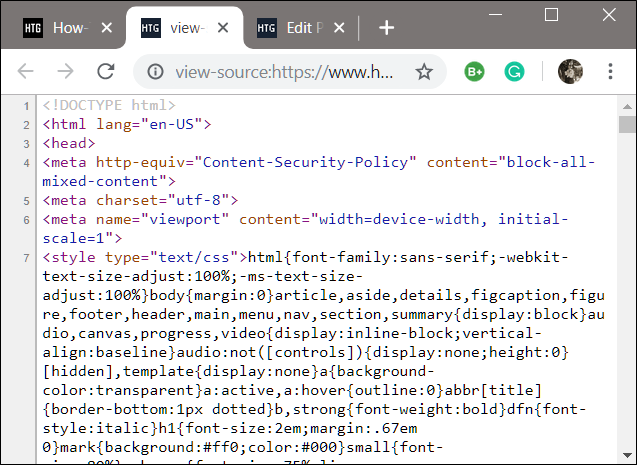
If you’re looking for a specific element or part in the HTML source, using View Source is tedious and cumbersome, especially if the page uses a lot of JavaScript and CSS.
This method uses the Developer Tools pane in Chrome and is a much cleaner approach to view the source code. HTML is easier to read here thanks to the additional formatting and the ability to collapse elements you aren’t interested in seeing.
Open Chrome and head to the page you want to inspect; then press Ctrl + Shift + i. A docked pane will open alongside the webpage you’re viewing.
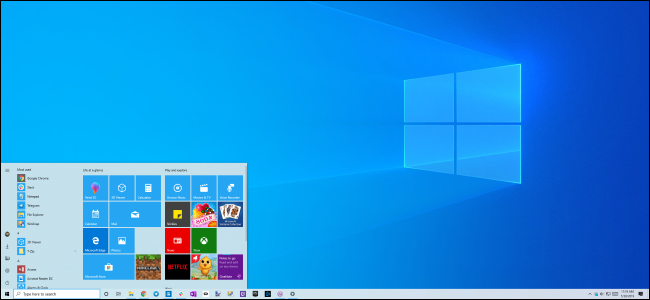
Windows 10’s May 2019 Update includes a new light theme and a brighter default desktop background to go with it. Here’s how to enable the shiny new theme and get a lighter looking desktop.
To enable the light theme, head to Settings > Personalization > Colors. To quickly open the Personalization section, you can right-click your desktop and select “Personalize” or press Windows+I to open the Settings window and then click “Personalization.”

Click the “Choose your color” box on the Colors pane and select “Light.”
This feature requires your PC has the May 2019 Update, which is Windows 10 version 1903. You won’t see this option if you’re using an older release of Windows 10.

For the previous Windows 10 default with a dark taskbar and light apps, select “Custom,” set your default Windows mode to “Dark,” and set your default app mode to “Light.” You can also select “Dark” in the color list for a dark desktop complete with dark File Explorer windows.
You can choose whether or not your windows have colored window title bars from this pane, too.

Did you just install the May 2019 Update? If so, there’s more than 10 GB of data wasting space on your hard drive—we had 24.6 GB! On a laptop or tablet with a limited amount of storage, this can fill up your device quite a bit.
If you have a computer with a large amount of available storage, you might not even notice this useless data. It’ll stick around for 10 days until Windows automatically cleans it up. But, if you’re pressed for space, you’ll want to clean it up as soon as possible.
Upgrading between “builds” of Windows 10–like from Windows 10’s October 2018 Update to Windows 10’s May 2019 Update–is treated the same as upgrading to an entirely new Windows operating system.
When you upgrade to a new “build,” Windows creates a Windows.old folder that contains the system files from your “old” Windows installation. This allows you to “go back” to the previous build of Windows 10 if you experience a problem with the new build.
RELATED: What is the Windows.old Folder and How Do You Delete It?
However, this folder can use more than 10 GB of space on your hard drive. Windows will automatically remove it after 10 days, but you can remove it sooner to free up the space immediately.
Warning: You should only do this if your PC seems to be working properly. If you have some issue with the new version of Windows 10 on your hardware, you won’t be able to “go back” to the previous build without completely reinstalling Windows after you wipe these files.
You can go back to the last build of Windows 10 you had installed by navigating to Settings > Update & Security > Recovery and using the “Get Started” button under “Go back to the previous version of Windows 10.” This button is only present if the files are still available on your computer.
The Communicator Used By Obi-Wan Kenobi In The Phantom Menace Is Actually A? |
|
Think you know the answer? |
|

Intel doesn’t make laptops. But in the past, it has occasionally used its power to guide laptop trajectory. If you remember Ultrabooks, that was an Intel drive to steer the future of premium laptops.
Now Intel is introducing Project Athena, only this time the focus isn’t premium laptops so much as long-lasting laptops. A Project Athena laptop (a branding name is coming later) should have nine hours of battery life. And if you’re thinking plenty of laptops reach that benchmark now, those are tested under ideal conditions. Typically a video playing with the screen brightness turned very low. Intel wants to test laptops with something closer to real-world conditions.
The company knows just saying, “make it laster longer” isn’t all that helpful, so Intel is also introducing a proposed feature to help reach that goal: presence detection. On prototype laptops, Intel showed a proximity sensor embedded next to the webcam. When you step away, the proximity sensor notices you aren’t near anymore and puts the device to sleep. When you come back, the laptop sees you and wakes up to the login screen. It’s pretty close to the method many smartphones use now.
As an alternative, Intel is also testing using a camera and facial recognition. The idea isn’t to save specific faces, at least not yet, but to recognize that some face is present and use that information to wake up the device or put it asleep. Unfortunately, in demonstrations, the tech was far too sensitive, and the Intel rep had to point the camera at the ceiling for the laptop to go to sleep. Plenty of fine-tuning is needed. And naturally, privacy implications with facial recognition technology will need to be addressed.
But I think we can all agree that laptop battery life that lasts longer would be a good thing. [Engadget]
Astronomers discovered a Neptune-like planet (designated NGTS-4b) about 920 light-years from Earth. Neptune-like planets aren’t necessarily unusual themselves, but this one is special. You see, it’s incredibly close to its star.
How close? Well, a single orbit around its star (what we call a year) takes less than two days. For comparison, Mercury, the closest planet to our Sun, takes just over 89 days to complete an orbit.
Usually, only small rocky planets (like Mercury) or massive and hot planets (like Jupiter) exist so close to a star. This is the first time astronomers have spotted a Neptune-planet so close to its star, and the discovery led to a new designation: a Neptune-desert.

A Comma Separated Value (CSV) contains data separated by commas (and sometimes other characters) and is generally used to exchange data from one application to another. If you have a list of data in a Word document, converting it to a CSV file can help you get it into other apps.
Let’s say you’ve been keeping all of your email contacts organized in a Word file and you’d like to let an online application clean it up for you. You’re likely going to need a CSV file to achieve this. In fact, several of these applications you’d find online may only support CSV files because the file works across the Mac, Windows, and Linux platforms. Pretty efficient.
Go ahead and open the Word file that contains the data to be imported. In this example, we’re going to be showing a very small email list.

As you can see, all of our data is separated by commas and are on separate lines, similar to the row/column structure you’d find in Excel. The structure of a CSV file can get a bit complicated, but this is a very basic example.
Once you’re ready, click the “File” tab located at the top-left of the window.

In the pane on the left-hand side, select “Save As.”
Pie charts are popular in Excel, but they are limited. You’ll have to decide for yourself between using multiple pie charts or giving up some flexibility in favor of readability by combining them. If you do want to combine them, here’s how.
For example, the pie chart below shows the answers of people to a question.
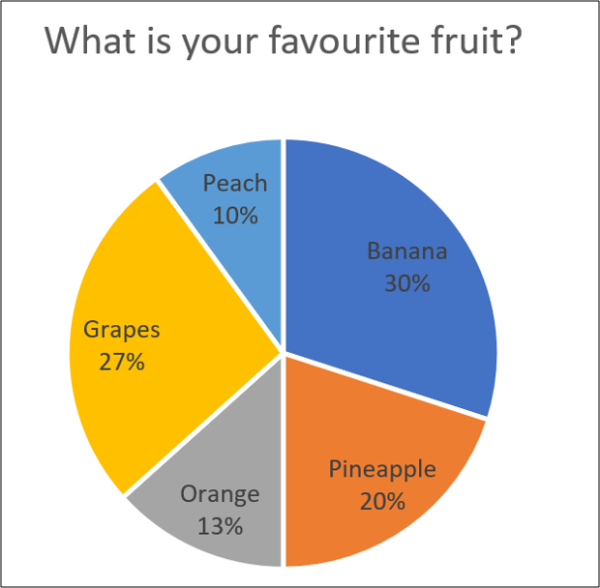
This is fine, but it can be complicated if you have multiple Pie charts.
Pie charts can only show one series of values. So if you have multiple series, and you want to present data with pie charts, you need multiple pie charts.
The image below shows the contribution to total revenues of five products across three different cities. We have a pie chart for each city with the data ranges shown above them.

This enables us to compare the sales of products across different cities. But there are complications when we want to change them all consistently, or view them as a single figure.
A Non-Functioning Gargoyle Is Known As What? |
|
Think you know the answer? |
|

PowerPoint can pop up an image when you hover your pointer over a thumbnail image. This lets you keep a nice, clean slide, but also show your audience more information when you want to.
In this example, we have four thumbnail images, and we want to set up a hover effect that shows a pop-up of a larger image when you mouse over each of the thumbnail images.
First, on a new slide, insert your thumbnail image by heading to Insert > Pictures. The thumbnail image is whatever small image you want to use as a thumbnail on your slide—not a special kind of image.

Here’s an example of our slide with four thumbnail images inserted.

Next, you’ll need to add a new slide for each of the popups for the larger images. Right-click on your first slide’s thumbnail, and then select “New Slide.” Repeat this step for any additional slides needed for each of your larger images.

Yesterday, the internet went wild when Dell published specs for its latest laptop that included a reference to a new Windows 10 version: “Windows 10 Home Ultra.” ZDNet, Thurrott (premium content), and Forbes were quick to report, dissect, and offer up possibilities, but it wasn’t long before Microsoft put out an official statement: “There is no new version of Windows called Windows 10 Home Ultra.”
Noticeably, that leaves a lot of wiggle room for a new version of Windows by a different name. Technically if the company released “Windows 10 Ultra”, that statement would still be valid.
That’s what makes Microsoft’s latest blog post all the more interesting. What started as standard affair covering new laptops and devices turned into a description of a new modern OS. Microsoft laid out a vision for the future where new devices would require a modern OS that provided “enablers and delighters.”
Microsoft clarified “enablers and delighters” as an OS that updates in the background, invisibly and without interruption. It went on to describe an OS that is “secure by default” with separation between “state” and “operating system.” Other buzzwords included “always connected,” “cloud-connected,” and “sustained performance” (a reference to battery life).
The word you don’t see in the two paragraphs describing this new modern OS is “Windows.” It’s a curious omission, but that doesn’t mean this Microsoft won’t name this OS Windows, we’ve been reporting on Windows Lite and Windows Core for some time now, and they could fit the bill.
We’ll have to wait for Microsoft to move from vague talk of a vision to future to concrete details of a vision for now to learn more. [Microsoft]
RELATED: The Future of Windows: What Are Polaris and Windows Core OS?
For years, the World Wide Web Consortium (WC3) set the standards for HTML and its future iterations. But Apple, Mozilla, and Opera disagreed with the group’s direction in the past and formed a group called Web Hypertext Application Technology Working Group (WHATWG).

Microsoft Outlook lets you create electronic sticky notes that you can display either in Outlook or right on your desktop, letting you get all those real sticky notes off your desk.
Before we start, let’s take a moment to remember that writing passwords down on Post-It notes, electronic or otherwise, is just plain bad. We’ve written about password security extensively over the years, so take a moment to pick a password manager and use it. One day you’ll thank us.
RELATED: Why You Should Use a Password Manager, and How to Get Started
The first thing to do is to open up the Notes option in Outlook. Do this by going to the bottom left of Outlook, clicking the three dots in the Navigation option, and then clicking “Notes.”

The Notes option, where you can add, edit, and delete your notes, will open up.

To create a new note, click “New Note.” This will create a new note with the default size and color.

Windows 10’s setup and upgrade process sometimes fails and says your PC “can’t be upgraded” but “no action is needed.” Windows knows the problem, but Microsoft hides the details from you. Here’s how to identify and fix the problem yourself.

Microsoft should provide more descriptive error messages. The message we saw while attempting to upgrade to Windows 10’s May 2019 Update with Microsoft’s Update Assistant was:
This PC can’t be upgraded to Windows 10.
Your PC has a driver or service that isn’t ready for this version of Windows 10. No action is needed. Windows Update will offer this version of Windows 10 automatically once the issue has been resolved.
Microsoft says a “No action is needed” message means you shouldn’t do anything.
That’s all well and good, but what if you don’t want to wait? Why doesn’t Windows tell us which “driver or service” is causing the problem? Windows 10 does know the problem, but it doesn’t display it here—you’ll have to dig it out of the log files and fix it yourself. Here’s how to do it.
The log files are hidden in this folder on your PC:
C:\$WINDOWS.~BT\Sources\Panther
In Your Average School Class There Is A 50% Chance Two People Share What? |
|
Think you know the answer? |
|
Huawei is in a tough position. Google pulled its Android vendor license, Intel, Qualcomm, and ARM refuse to work with the company, Microsoft pulled its laptop and cloud offerings, and now the mobile company finds itself ejected from the SD and Wi-Fi standards associations.
If you want to make a product that uses SD cards, you need to join the SD Association. It’s a non-profit organization that sets standards for SD and microSD cards, and to membership is required to build products that use the standard.
Without the membership, you can’t make SD cards, and you can’t make products that work with SD cards. And now Huawei isn’t a member. So going forward any new phones it develops can’t use Google apps, must rely on stock Android (or the backup OS the company claims to have in the works), find some other mobile processor besides ARM’s to use, and forgo SD cards in its devices.
To make matters somewhat worse, it appears the Wi-Fi Alliance also ejected Huawei. Ejection isn’t quite as dire, Huawei can continue to incorporate Wi-Fi into its products, but it won’t get certification for those products.
All of this only affects the future, though, anything that already made it through the process should be covered. But the future is rapidly approaching, and Huawei is not in a good position to meet it. [Android Police]
The World Health Organization (WHO) decided to officially place “gaming disorder” to its list of “globally recognized diseases.” Before you get out your pitchforks, this isn’t some statement that all gaming is bad or anything of the sort.
The Who classifies Gaming disorder with the following patterns of behavior:
“1) impaired control over gaming (e.g., onset, frequency, intensity, duration, termination, context);
2) increasing priority given to gaming to the extent that gaming takes precedence over other life interests and daily activities; and
3) continuation or escalation of gaming despite the occurrence of negative consequences. The behaviour pattern is of sufficient severity to result in significant impairment in personal, family, social, educational, occupational or other important areas of functioning.”

Excel provides a plethora of features for organizing, manipulating, and handling your data. One of these unique features is inserting a PDF directly into Excel. The good news is it only involves a few simple steps to do it. Here’s how.
In the Excel file, head over to the “Insert” tab and then click the “Object” button.

In the Object window that appears, switch to the “Create from File” tab and then click “Browse.”

Browse to the location of your file, select the file, and then click “Open.”

Back at the “Object” window, you’ll see the file path of your PDF. Now, you need to tell Excel how you want the file to appear in the spreadsheet. There are a few different options here. If you select “OK” without taking any further action in the “Object” window, the PDF file appears in Excel showing the contents of the PDF in its entirety.

You can change the display resolution of your Mac to make text larger or gain more space. There are some predefined scaled resolutions available, but you can get more granular control over your display’s resolution.
Normally a Mac will run its display at the resolution Apple believes is best. There are also four or five different options—depending on your Mac and display and highlighted below—that provide different outcomes. They’re fine, but they’re options to make text bigger or your desktop larger without using the number-based resolutions we all understand. But if you do some digging, you can get some real control over your display by making actual resolutions available to you.

RELATED: How to Run Your Retina Display at its Native Resolution
A display’s resolution is the number of pixels available both horizontally and vertically. A 4K display has a resolution of 3840 x 2160 pixels, or 3840 pixels horizontally, and 2160 pixels vertically.
How much information you can see on-screen at any given time is governed by its resolution. Higher resolutions mean that more things can be shown on-screen. Those things could be windows, icons, photos, or text in a document. Because of the larger resolution, however, that also means all on-screen elements are smaller, which is something else to consider.
Larger displays usually also have higher resolutions than smaller ones, especially if they are of good quality.

Personalizing your icons is a great way to make a PC uniquely yours. Let’s take a look at the different ways Windows lets you customize your icons.
RELATED: How To Make High Resolution Windows 7 Icons Out of Any Image
Windows has some built-in icons you can choose from, but there is also an untold number of icons you can download from sites like IconArchive, DeviantArt, and Iconfinder—all of which have loads of free icons. And if you can’t find something you like, you can even make high-resolution icons out of any image.
Once you have the icons of your dreams, save them in a safe place—some of these processes will require they stay in a particular location on your PC. In other cases, you’ll probably want them there just in case something goes wrong and you have to re-apply them.
Icons like This PC, Network, Recycle Bin, and your User folder are all considered “desktop icons,” even though modern versions of Windows don’t show them all on the desktop. Windows 8 and 10 don’t show any of the desktop icons except for Recycle Bin, and even Windows 7 doesn’t show them all. For a complete rundown, check out our guide to restoring missing desktop icons in Windows 7, 8, or 10.
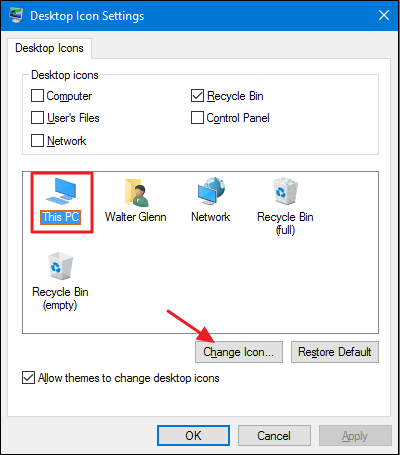
But you can still change how these icons appear elsewhere on your system. To do so, you’ll need to access the “Desktop Icon Settings” window to turn these icons on and off or to change the associated icons. In Windows 10, you can access this window through Settings > Personalization > Themes > Desktop Icon Settings. In Windows 8 and 10, it’s Control Panel > Personalize > Change Desktop Icons.
Use the checkboxes in the “Desktop icons” section to select which icons you want on your desktop. To change an icon, select the icon you want to change and then click the “Change Icon” button.

After months of rumors, the Google Pixel 3a is finally available. It’s a more affordable take on the company’s flagship phone, with corners cut in all the right places. It’s 90 percent of the Pixel 3 at half the price.
It still offers most of the things that make the Pixel 3 special: an excellent camera, Pixel-specific Android with updates directly from Google, the crazy-fast and convenient rear fingerprint sensor, and meaningful software features—all for a starting price of $399 for the Pixel 3a ($479 for the 3a XL).
Of course, at half the price, it’s also missing a few things: wireless charging, waterproofing, “premium” materials, and a top-of-the-line processor. But what it lacks in so-called “high-end” features, it makes up for in…well, everything else.
The most exciting part of the 3a is that it still offers the Pixel 3’s best feature: that killer camera. Since most of the magic is in the post-processing on Pixel phones, Google was still able to offer things like portrait mode, Night Sight, and other excellent camera features in the 3a.
Before we get into the nitty-gritty, it’s worth mentioning that this review focuses on the smaller of the two 3a phones. Since the 3a XL is basically the same phone with a bigger screen, however, you should be able to apply everything said to it, as well.

As manufacturers have shifted to use more “premium” materials like aluminum and glass in phones, handsets have also gotten more slippery, fragile, and expensive. I don’t know about you guys, but I’m not into any of those things. Despite the direction the phone industry has been moving in, I’ve longed for a plastic phone worth using. The Pixel 3a is the answer to that longing.
So, why plastic? Because it’s light, it’s nearly indestructible, it doesn’t scratch easily, and it’s not slippery. What more do you want from a phone’s body? I can’t think of anything better—“premium” materials be damned. And the 3a is plastic done right. Some plastic phones can feel cheaply made, but this little guy feels excellent. It’s a well-made little device. The plastic on the 3a is excellent (though it is a fingerprint magnet).

Chrome Extensions are powerful tools that let you customize your browser experience to your liking. While these have historically only been available on the desktop, a recent update to the Kiwi Browser brings support for desktop extensions to Android.
Kiwi is an open-source browser for Android devices based on Chromium and the WebKit rendering engine. Since it uses the Chromium source, it has a very familiar look and feel, but it also packs its own features to make it unique and useful.
Right out of the box, it blocks intrusive ads by default, blocks pop-ups, and has protection against cryptojackers. It can also block site notifications, as well as block AMP pages for users who prefer to go directly to the site. Mostly, it’s a more privacy-focused version of Chrome with various speed improvements.
Since it’s just based on Chromium and not actually Chrome, however, you’ll lose out on things like account syncing between devices, which means you’ll have to manually bring your bookmarks and stuff like that to Kiwi if coming from Chrome.
All that aside, there’s one primary feature that’s relatively new to Kiwi that we’re going to focus on today: desktop extension support. We’re talking about all your favorite extensions from Chrome on the desktop, just on your phone. It’s pretty rad. Here’s how it works.
Before we get to the nitty-gritty, we should probably talk about why Google hasn’t brought Chrome extensions to Chrome on Android. To put it bluntly: because the experience basically sucks.
Chrome extensions are mostly (or entirely?) designed with the desktop in mind, so it’s no surprise that many of them don’t offer a lot of benefit on mobile. In fact, none of the extensions I use in Chrome desktop were worth a flip on mobile.
Your mileage will vary from extension to extension—some may work well, some may only partially function. Some may not work at all. The only way to really know is to test it out.
In The 1960s, RCA Invented A Record That Could Play? |
|
Think you know the answer? |
|

Cotton candy is more than just some sugary snack; it’s the lifeblood of our collective childhood. Whether you’re hosting a party, feeling nostalgic, or craving for a sweet snack, a cotton candy machine is an absolute necessity.
Like most snack foods, cotton candy is shrouded in mystery. How do people make cotton candy? How much does a cotton candy machine cost? Do I need to work at a carnival to learn some cotton candy skills through an ancient trade system handed down since the Middle Ages? Turns out, making cotton candy is easy and affordable. All you need is a cotton candy machine and some sugar.
The thing is, there are a ton of cotton candy makers on the market, and some work better than others. That’s why we’ve taken the time to find the best cotton candy machines, from tabletop models to commercial behemoths. Just keep in mind that most of these machines don’t come with any sugar. You can get away with using hard candies (like peppermints) for some funky creations, but if you want the real-deal experience, you’ll need some cotton candy sugar.

Put on those nostalgia goggles for a minute, and look back on your childhood. You see smiling faces, flowers, carnival rides, and a sweaty older man handing out colorful cotton candy. Now take off those nostalgia goggles, and take a gander at the Nostalgia Electrics cotton candy maker. This old-timey machine can bring a childhood of sweet cotton candy right to your kitchen countertop.
This affordable machine is easy to use and easy to clean. And since it’s surrounded by a steep plastic dome, you don’t have to worry about making a mess on your countertop. Plus, this cotton candy machine comes with two reusable cones and a plastic sugar scoop, so the only extra thing that you need to buy is some sugar. It’s a great pick for light use at home as it takes up minimal space but still offers an authentic cotton candy experience.

OK, OK, you got us. This pick has the same guts as our best overall pick above. But if the 1950s gumball-machine aesthetic of the Nostalgia Electrics cotton candy maker doesn’t do it for you, then you should check out the carnival-styled Nostalgia cotton candy maker. Given that cotton candy is often used for celebrations like children’s parties or baby showers, we couldn’t resist adding in this extra old-timey option.
Like the previous Nostalgia brand model, it sports a medium-size floss bowl, can accept both flossing sugar as well as hard candies and includes a dome guard and reusable cones. The real difference is the form factor, where instead of an old-timey jukebox vibe you’ve got an old-timey carnival cart vibe—you know, without the expense of buying an actual cart. If the cart is what you’re after, however, do keep scrolling.

Portable applications offer some definite advantages over their traditional counterparts. They’re lightweight, and they allow you to move between computers while taking your apps and settings with you. Here’s why they’re different and why they’re sometimes—but not always—a good choice.
RELATED: What Is the ProgramData Folder in Windows?
To understand what makes an app portable, it might be helpful first to take a quick look at how traditional apps get installed in Windows. When you install an app in Windows, the installation files go to several different locations. The bulk of the app’s files are usually copied to a single folder somewhere in the C:\Program Files folder. Files that contain settings applying to all users of the app may get created in the ProgramData folder.

Settings that are particular to different user accounts on the PC are stored in files created in the hidden “AppData” folder inside each accounts user folder. Most apps create entries in the Windows Registry that may also hold various configuration settings. And many apps take advantage of shared code libraries that get installed with things like the .NET framework and Visual C++ Redistributables.
There are distinct advantages to this separation of functions. Multiple apps can share information contained in Registry entries or shared code libraries, preventing unnecessary duplication. Storing user-specific settings in one place and system-wide settings in another means that apps can take better advantage of lots of different Windows features designed for a multi-user system. For starters, each user can rely on their own settings being loaded when they start the app just because they are signed in with their own Windows account. Features like file and share permissions are built on this structure. And, having all program settings saved to designated areas makes backing up your system more reliable.
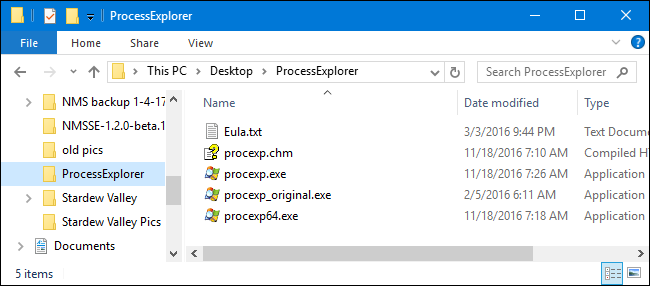
A portable app is simply one that doesn’t use an installer. All the files required to run the app reside in a single folder, which you can put anywhere on the system. If you move the folder, the app will still work the same. Instead of installing a portable app, you typically download it as a ZIP file, extract that ZIP to a folder, and run the executable file for the app. If the app allows you to save settings, those settings are saved in files right inside the same folder.